
Financial Support Navigator

IT platform account

Sustainable Development

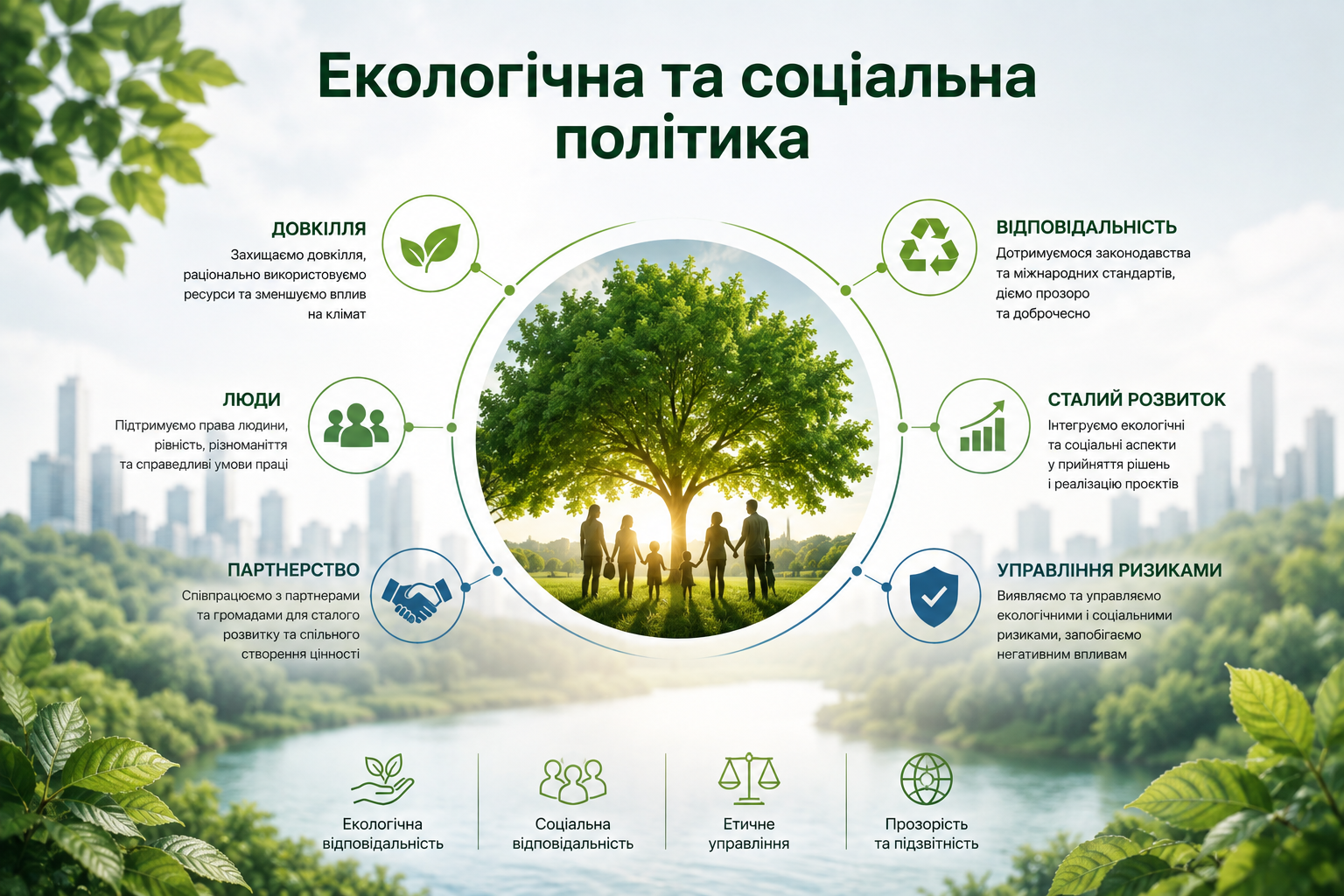
The National Development Institution supports financing that fosters Ukraine’s economic development while ensuring responsible management of environmental and social risks in accordance with international standards.

Governance Framework

Policies and Documents

Three key documents that define the principles, framework and strategy of the NDI’s Environmental and Social Management System (ESMS).

Environmental and Social Policy of the NDI

Principles

Environmental and Social Policy

Defines the principles of responsible financing, the integration of international environmental and social standards, and the management of environmental and social risks. It serves as the foundation of the NDI’s Environmental and Social Management System (ESMS).

PDFDownload document

Environmental and Social Management System

Mechanism

Environmental and Social Management System (ESMS)

The practical mechanism for implementing the Policy. It provides a systematic approach to assessing, monitoring and managing environmental and social risks, integrating international standards into the financing process.

Document in preparation

Sustainable Development Policy of the NDI

Strategy

Sustainable Development Policy

Sets out the strategic vision for embedding sustainable finance principles and integrating ESG approaches across all areas of the Institution’s activity, for long-term positive impact on the economy, society and the environment.

PDFDownload document

For Partners and Clients

Training Materials

Resources for partner banks and businesses on the application of environmental and social requirements. This section is currently being developed — please check back for updates.

WebinarsComing soon
PresentationsComing soon
VideosComing soon
Training recordingsComing soon

Help

Frequently Asked Questions

What is an ESMS?
An Environmental and Social Management System (ESMS) is a set of policies, procedures and defined roles that enables an institution to systematically identify, assess and manage environmental and social risks throughout the financing cycle — from initial screening to post-disbursement monitoring.
Which projects are subject to assessment?
All projects financed with the participation of the NDI undergo environmental and social screening. The scope of the assessment depends on the project’s risk category: low-risk projects require only a basic review, while high-risk projects are subject to a detailed assessment and the development of an environmental and social risk management plan.
How do partner banks categorize projects?
Partner banks classify projects according to their potential environmental and social impacts, in line with the IFC Performance Standards and the requirements of the NDI’s ESMS. The risk category is determined during the application review process and defines the required documentation, the scope of due diligence and the frequency of subsequent monitoring.
How should incidents be reported?
Partner banks must notify the NDI of any significant environmental or social incidents related to financed projects within the timeframes established by the financing agreement and ESMS procedures. Incident reports should include the date, location, nature of the incident and the corrective actions taken.
What are the IFC Performance Standards?
The IFC Performance Standards are eight internationally recognized standards developed by the International Finance Corporation. They establish requirements for managing environmental and social risks, covering areas such as risk assessment, labour and working conditions, resource efficiency, biodiversity conservation, community health and safety, and stakeholder engagement. They serve as a global benchmark for development banks and financial institutions.