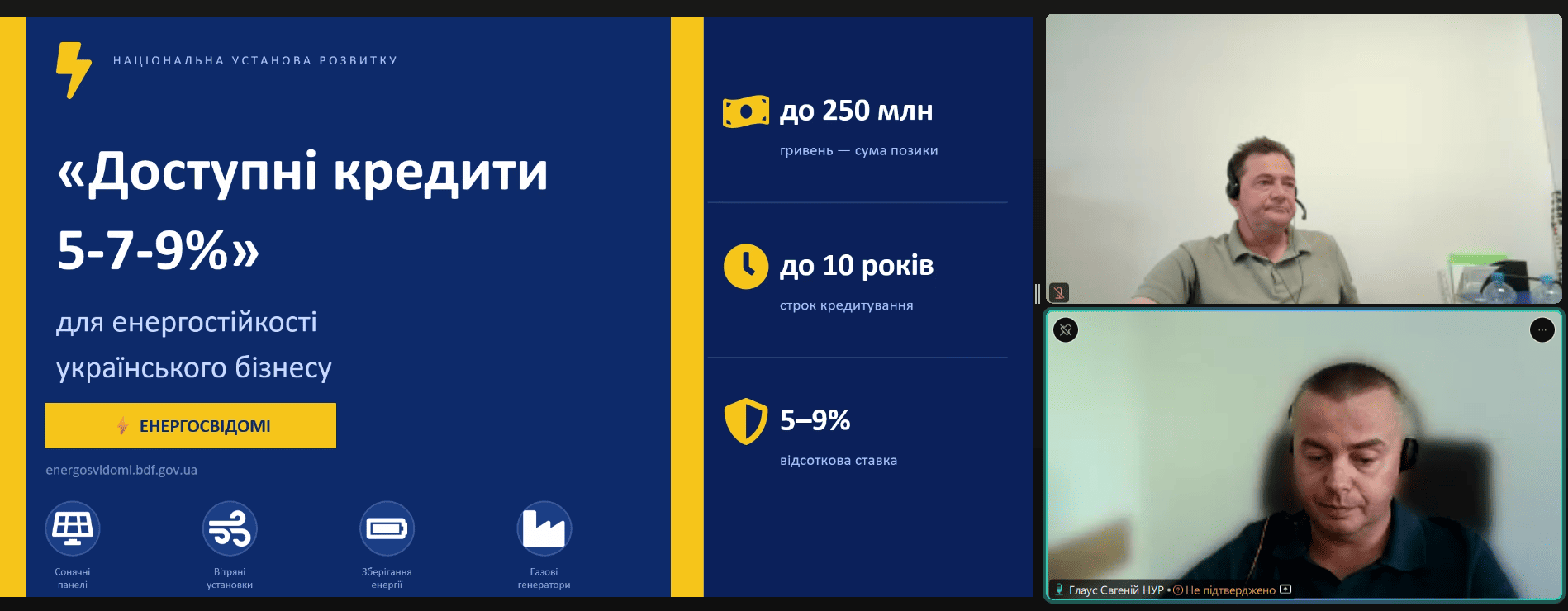
During the “Business and Government Dialogue” meeting organized by the Khmelnytskyi Regional Military Administration, Yevhenii Hlaus, Head of State Programs at the National Development Institution, presented support programs designed to help businesses invest in their energy independence.
Russian strikes on energy infrastructure compel enterprises to seek alternative on-site power sources—deploying generators, solar panels, energy storage systems, and cogeneration units. At the same time, acquiring such equipment using their own funds remains difficult for many companies.
To address this, the institution offers three financial instruments covering various business needs, from small investments to large-scale self-generation projects:
- “Energy Resilience” (under the Affordable Loans 5-7-9% Program): Designed for micro, small, and medium-sized businesses (MSMEs). Provides loans up to UAH 250 million with a maturity of up to 10 years at an interest rate of 5–9% per annum. Funds can be allocated to solar and wind installations, energy storage, as well as gas, biogas, and cogeneration units.
- “0% Energy Loans”: Offers financing without loan overpayments, thanks to full state interest-rate compensation. The program is primarily targeted at micro and small businesses, making energy independence accessible even for small enterprises.
- “Energy-10”: An instrument for mid-sized and large enterprises planning large-scale investments in self-generation. Loan amounts range from EUR 1 million to EUR 25 million in UAH equivalent at an interest rate of 10% per annum. The program covers gas-turbine and gas-piston engines, renewable energy facilities, energy storage systems, and related infrastructure.
- “Together, these instruments form a comprehensive financial support framework—ranging from a small generator for an individual entrepreneur to an industrial cogeneration unit for a large enterprise,” noted Yevhenii Hlaus.
To participate, businesses must apply to one of the partner banks and undergo standard project evaluation. Currently, 43 partner banks are engaged in the rollout of these state programs, providing entrepreneurs with a broad choice of financial partners.